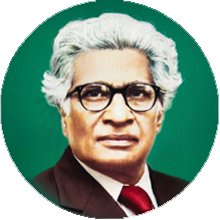
Manabendra Nath Roy
(21 March,1887 - 25 January 1954)

Ellen Gottschalk Roy
(15 August 1904 – 13 December 1960)
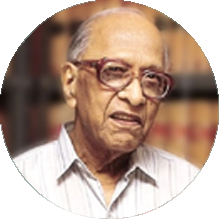
Vithal Mahadeo Tarkunde
(3 July 1909 -22 March 2004)
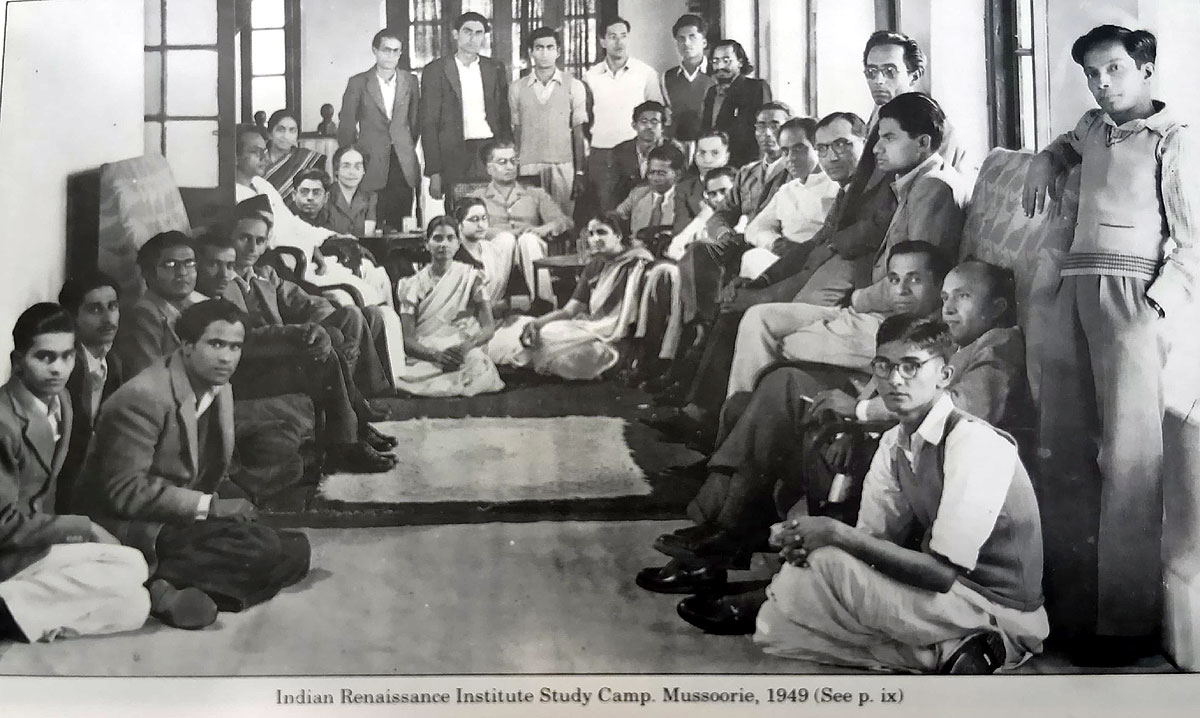
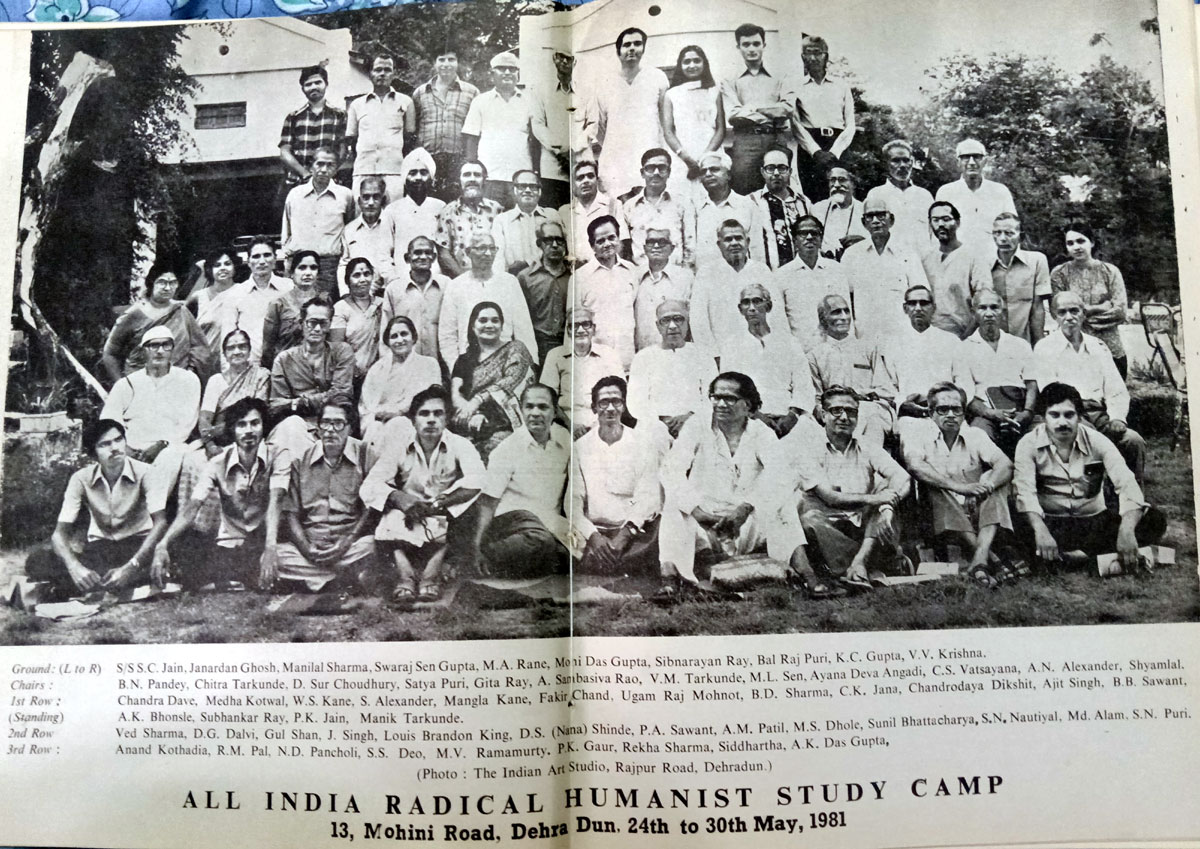
The Indian Renaissance Institute (IRI) was founded on November 20,1946 as a non-profit organization and registered under the Societies Registration Act,1860, with a view to developing a Renaissance movement in Indiaon the basis of scientific humanism.M.N. Roy was the founder and guiding force of the Institute.However, Ellen Gottschalk Roy and V.M. Tarkunde played nolessan important role in establishing and developing it. Theorigin of the idea can be traced in the correspondence between Ellen Roy and M.N.Roy which exchanged between them when latter was in British jail during 1931-1936. The idea was further discussed and debated inthe study camps held at Dehradun in the wake of World War II (1939-1945) and finalized. V.M.Tarkunde, who was the General Secretary of the Radical Democratic Party,played major role in the deliberations. After the demise of M.N. Roy, Ellen Roy and Tarkunde continued to work for its development. It can safely be said that M.N. Roy, Ellen Roy and V.M. Tarkunde were the three architects of the Institute.
“There is no reincarnation, no God, no Heaven, no Hell; all traditional religious literature is the work of conceited fools; nature, the Originator, and time, the Destroyer, are the rulers of things, and take no account of virtue or vice, in awarding happiness or misery to men; people deluded by flowery speeches, cling to God’s temples and priests……”
(Swasanvedyopanishad, Eliot II, p.322)
(Quoted in the lecture captioned ‘Indian Renaissance” delivered by M. N. Royand published in the Radical Humanist Vo.XIX No.9 and10, Feb.27, 1955 and March 6, 1955)
Towards Formation of IRI
Before describing objectives and programme of the IRI it would be useful to narrate the motivation and ideas which led to the formation of the Institute. Life of M.N. Roy was full of adventures – adventures in the field of action as well as in the field of ideas. In 1942 Roy had concluded that the war (the Second World War) was going to end soon in favour of the democratic powers led by England against the Fascist combination. He therefore directed his attention to the post war reconstruction, especially to the question of the post war economic development of the country.
Indian Federation of Labour (IFL) – the labour wing of the Radical Democratic Party of Roy, set up ‘Post War Reconstruction Committee’ which prepared the People’s Plan for Economic Development. The IFL passed a resolution that labour must have effective voice in the government. The Industrialists’ Bombay Plan was published at the same time. The country had thus before it two plans, one prepared by a labour organization and the other by big business.
At the same time, his book ‘Poverty or Plenty’ was published. Political reconstruction was as necessary as economic reconstruction. The People’s Plan was, therefore, followed in a couple of months by the draft of a Constitution of Free India prepared by M.N. Roy and released for public discussion in December 1944. It came to be known as Draft Constitution.
However, Roy had not stopped thinking about more fundamental ideological and philosophical problems. Why did communism degenerate into nationalism? Is it possible to evolve a liberating philosophy on the basis of the freedom and happiness of the individual? What is the relation between the individual and the society? Is human civilization doomed to destruction ? Is pursuit of power through political parties the only goal of political activity? Is it possible to reorganize political and social structure and make it more compatible with individual freedom and social advance? These and many similar questions had tortured his mind for several years.
He held discussions and study camps with colleagues. The result was the philosophy of the Radical Humanism. In his view humanism provided the ideological foundation of modern democracy and the birth of modern democracy was preceded by the European Renaissance which revived the humanist values of individual freedom, rationalism, self-reliance, and secular morality. These values not only created the preconditions of democracy but led to the development of modern science which ushered in the industrial revolution. It was humanism which modernised the western world.
Roy was of the opinion that India needed a Renaissance movement in the same way as it took place in Europe around 14th to 19th centuries. The Renaissance was a phase of man’s age long struggle for freedom; it revived the rationalist view of human progress. It represented the revolt of man against the tyranny of teleological reason and the theological moral order which had reduced man to the helpless position of a mere cog in the vast wheel of the law governed universe. The men of the Renaissance revolted against that degradation.
Throughout the Middle Ages learning remained confined to cloisters and schools under the patronage of the church. The men of the Renaissance challenged that spiritual monopoly. It maintained that the law governed universe did not preclude revolutions to be brought about by man’s will to freedom and urge to create.
However, the under-developed country like India did not go through the cultural revolution like the one brought about by the Renaissance movement in Europe. The school of thought which came to prevail in this country was the ‘other-worldly Vedant philosophy’. It regarded physical existence to be an illusion, the human body to be the prison-house of the soul, and escape from the cycle of births and deaths to be the highest human ideal. Self-denial, abstinence, celibacy and meditation became the highest virtues. The best spirits being thus preoccupied in other-worldly pursuits, the rest of the society came easily under the domination of ambitious and self-seeking priests. The theory of Karma, which says that our suffering of today is the result of the sins committed by us in previous lives, reconciled the poor to their miserable lot, consolidated the prevailing caste system and the barbaric custom of untouchability.
An age of cultural and intellectual darkness, an Indian version of the medieval Dark Age of Europe, descended on the country. There was indeed an analogous movement in India in the latter half of the last century but it was soon over whelmed by revivalist nationalism. In consequences, the bulk of the people continued to remain under the influence of religious orthodoxy, fatalism, and blind faith, and the humanist spirit of nationalism and self-reliance was confined to a minority. In such a situation, democratic institutions which were going to be introduced on the attainment of national independence were bound to remain weak and unstable.
“India was conquered again and again because the Indians did not value freedom, and did not therefore fight for freedom.They have always been taught not to bother about what is happening today, that the things of this life do not matter; that they must think of the future life, because this world is ‘Maya’ .”
(Quoted in the lecture captioned ‘Indian Renaissance” delivered by M.N.Roy and published in the Radical Humanist Vo.XIX No.9 and 10, Feb.27,1955 and March 6,1955)
In a speech he stated:
“…..You could not help noticing the importance I have been attaching to the need of a Renaissance movement to deal with cultural questions and philosophical problems,”
and further wrote in an article captioned as “Indian Renaissance” published in Independent India, Volume XII, Nos.22 and 23, June 6,1948 and June 13, 1948:
“ An all-round progress of the Indian people, such as will bring them abreast with other peoples of the modern civilized world, requires a social revolution, and the social revolution, in its turn, requires a philosophical revolution, in other words, a change in traditional mentality of India. That change is known in history as a ‘Renaissance’. The object of the Renaissance movement in India is to bring about that change and to carry that message of the revolt of man far and wide, so that a sufficient large number of men and women see that established notions, old beliefs, traditional authorities, venerable dogmas, are setting limits to the possibility of development of the Indian people. It is no longer a question of changing one political government for another; the mentality of the Indian people must change before it can go forward in its march towards real freedom and progress and thus come abreast with the rest of modern mankind.”
These were the basic ideas which led to the making of the Indian Renaissance Institute.
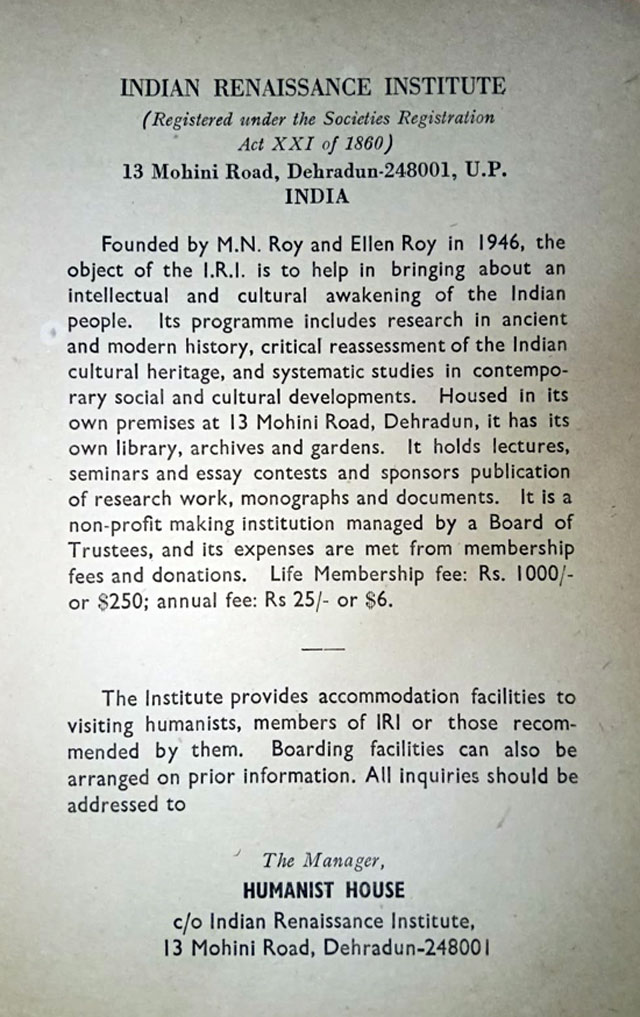
AIMS AND OBJECTS
The object of the society is to help the rebirth of the Indian people after centuries of stagnation in the backwaters of the world. There are ups and downs in the history of peoples. Before they entered the period of modern civilization, European peoples slumbered in the darkness of the Middle Ages, which lasted for nearly a thousand years. The intellectual and cultural resurgence in the fifteenth and sixteenth centuries was inspired by the Greco-Roman Antiquity. The previous heritage of ancient learning and culture fired the imagination of the Renaissance movement, which opened up a new chapter in the history of the European peoples.
It is historically necessary for India also to make a similar experience in order to come out of the twilight of a long period of social and cultural stagnation. Intellectual efforts to rescue the positive contributions of ancient thought and learning to inspire a great intellectual and cultural resurgence are the crying need of the day. Those contributions are the heritage of the Indian people, who have remained for centuries steeped in ignorance and superstition, glorified as the spiritual genius of India. The India people should come into their heritage if they are to occupy their place in the modern world and contribute to its reconstruction as the home of a truly free mankind.
Spiritual freedom, the individual becoming conscious of his dignity and sovereignty, is the greatest freedom. The noble ideal of Humanism should inspire a resurgent and renascent India, so that the positive contributions of her ancient culture, revalued in the light of the experience of modern humanity, might not only place her on the road to a future brighter than her venerable past, but also enrich the totality of human heritage.
Indian antiquity is much more remote today than the Greco-Roman antiquity was at the time of the European Renaissance. The ancient Indian learning and the teachings of the sages of antiquity have come down to us heavily adulterated with spurious matters of subsequent interpolations. They are known to us mostly through tendentious interpretations; the originals are almost lost. Several bright chapters of India’s past history are practically forgotten. They must be recovered if the intellectual achievements and cultural traditions of India are to be rescued from the ruins of her Middle Ages, of theological bigotry, Sacerdotal orthodoxy and appalling mass ignorance. To make the positive contributions of thought and learning of ancient India shine in their pristine purity so as to inspire greater intellectual efforts and bolder adventures of ideas, history will have to be critically studied and scientifically reconstructed. That is a stupendous task, which can be accomplished only by a brotherhood of numerous scholars, imbued with the iconoclastic spirit of enquiry and learning and qualified to carry on historical research according to modern scientific method.
The Indian Renaissance Institute proposes to be that intellectual brotherhood, engaged in the historical task of submitting tradition to a critical examination with the object of discovering our immortal heritage, which will illumine the part to a more glorious future.
The rebirth of people presupposes revaluation of traditional values. The past is dead. It cannot be resurrected. Renaissance is not revival. It is efflorescence of a new life, pulsating with new ideas, inspired by new ideals, and looking out to a new horizon. While delving into the past to find an inspiration for the future, it must not be forgotten that the present also is determined by the past. Judged by the present, the past could not have been free from all evil. That lesson should guide our approach to history. That is the spirit of Renaissance. To foster that spirit is the object of this society.
With the torch of enlightenment in our hand, we shall retrace Indian history to discover the permanent intellectual and cultural values created in the past. We shall make those genuine treasures shine as against the false glamour of spurious traditional values having no greater sanction than the ignorance and the superstition of the masses. Ours is the search of truth, which is not limited by space and time, which is cosmopolitan as well as eternal. Armed with the truth of modern scientific knowledge, we shall be more qualified to discover and appreciate what is true and imperishable in Indian Tradition.
Indian Renaissance coincides with the greatest crises in the history of mankind. It may have the privilege of helping the solution of the crises if it will reinforce Cosmopolitan Humanism, as the common heritage of the race. In that case, Indian Renaissance will merge into a much greater movement embracing the entire civilized world. The society will work for that grand consummation of its object, which is search for truth and enlightenment.
Its rules and regulations are published elsewhere on this website.